
What Is a Port Master Plan? A Practical Guide for Port Owners and Developers
If you ask ten people what a port master plan is, you'll probably get ten different answers.
Some see it as a planning document. Others think it's an engineering study, while some treat it as a wish list for future investment.
In reality, it's a bit of all three.
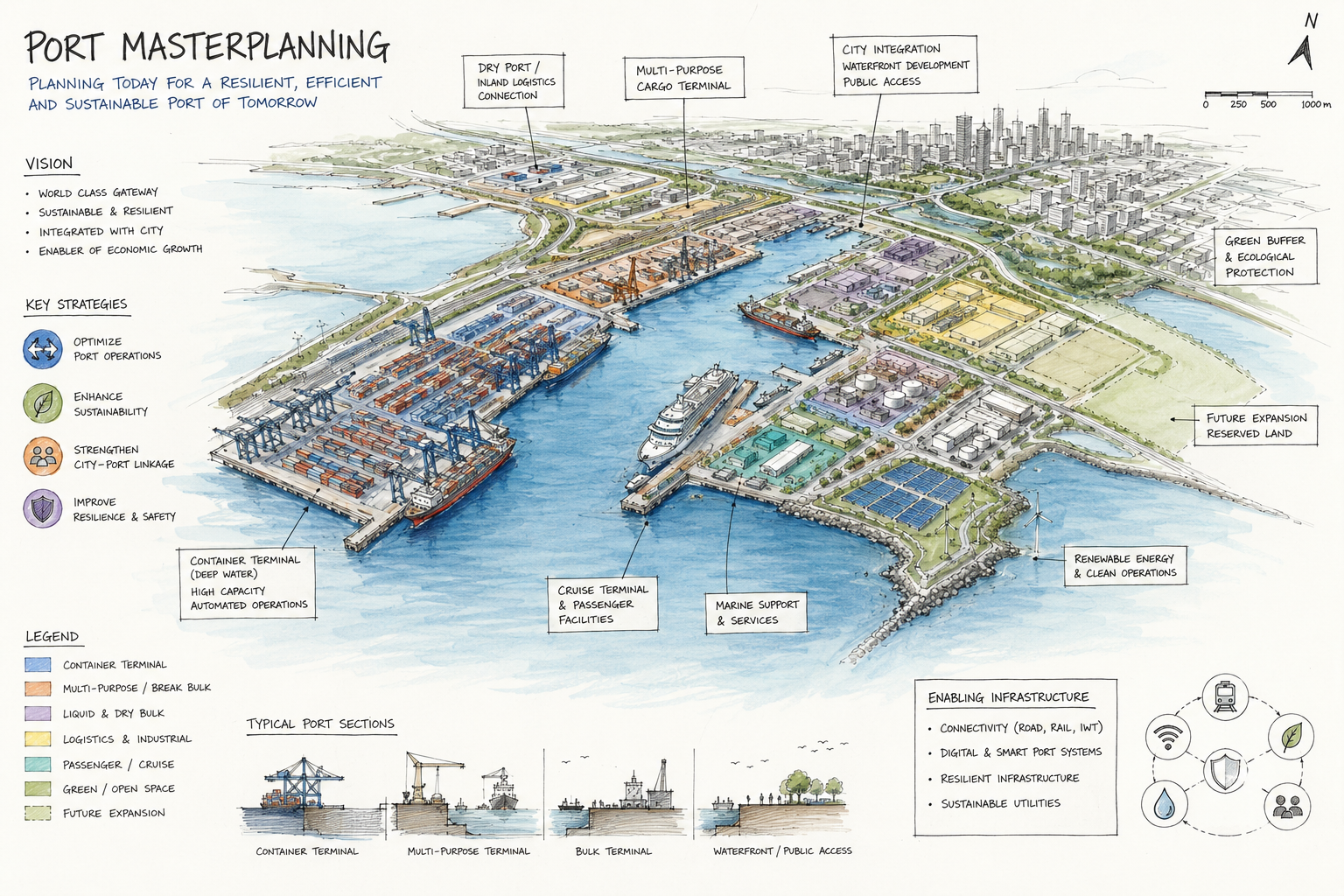
A good port master plan provides a clear, long-term vision for how a port, harbour or marina should develop over time. It brings together engineering, operations, commercial objectives and environmental considerations into a single strategy that helps guide investment over the next 20 or 30 years.
Most importantly, it helps ensure that today's decisions don't become tomorrow's constraints.
Why do ports need a master plan?
Ports are constantly evolving.
Vessels get larger, cargoes change, regulations develop and infrastructure inevitably ages. At the same time, operators are under pressure to improve efficiency, reduce maintenance costs and make the best use of the space they already have.
Without an overall strategy, it's easy for development to become reactive.
A new berth gets built because demand has increased. A warehouse is relocated to solve an immediate operational issue. A quay wall is repaired because it's reached the end of its service life.
Each of those decisions may make sense on its own, but unless they're considered as part of a wider plan, they can make future expansion more difficult and ultimately more expensive.
A port master plan helps tie everything together.
What does a port master plan include?
Every port is different, but most master planning studies consider the same core questions.
How does the port operate today?
How is demand likely to change?
What infrastructure will be required over the coming decades?
How can investment be phased to minimise disruption while delivering the greatest long-term value?
To answer those questions, a master plan typically considers:
Existing infrastructure and asset condition
Future berth requirements
Vessel movements and navigation
Quay wall and marine structure improvements
Road and rail access
Operational layouts
Environmental constraints
Marine licensing requirements
Climate resilience
Asset maintenance strategies
Future development opportunities
The aim isn't simply to identify what could be built. It's to understand what should be built, when it should happen and how different projects fit together.
Engineering should come first
One of the biggest mistakes we see is engineering being brought into a project too late.
By the time engineers are involved, layouts have often been agreed, budgets allocated and expectations set.
Unfortunately, that's sometimes the point where difficult conversations begin.
Ground conditions may not support the proposed development. Existing structures may not have the capacity that was assumed. Environmental constraints might affect construction methods or timescales.
Bringing engineering into the discussion at the very beginning usually saves both time and money.
Understanding what's technically achievable before major decisions are made gives everyone far greater confidence moving forward.
It's about more than new infrastructure
Master planning isn't always about expansion.
Some of the most successful projects focus on making better use of what's already there.
We've worked with clients looking to extend the life of existing quay walls, improve vessel access, optimise operational layouts or prioritise maintenance across ageing marine assets.
Sometimes relatively small engineering interventions can deliver significant operational improvements without the need for major capital investment.
That's where a good understanding of existing infrastructure becomes invaluable.
Environmental and consenting considerations
Modern ports don't operate in isolation.
Every development has to balance operational requirements with environmental responsibilities and regulatory requirements.
Marine licensing, planning policy, habitat protection and environmental assessments all influence how and when projects can be delivered.
Considering these factors during the master planning stage allows potential issues to be identified early rather than becoming programme delays later in the project.
Good planning isn't about avoiding regulation.
It's about designing projects that work within it.
Planning for the future
One factor that's becoming increasingly important is resilience.
Ports built decades ago weren't necessarily designed for today's operational demands, let alone tomorrow's.
Sea level rise, changing storm patterns, larger vessels and ageing infrastructure all need to be considered when planning future investment.
That doesn't always mean bigger structures.
Sometimes it means designing infrastructure that's easier to maintain, can be adapted in future or allows phased expansion as operational requirements change.
Thinking ahead almost always costs less than reacting later.
When should a master plan be reviewed?
A port master plan shouldn't be treated as a document that's written once and forgotten.
Most look ahead 20 to 30 years, but they should be reviewed periodically to reflect changes in trade, legislation, technology and operational priorities.
For many ports, revisiting the strategy every five years helps ensure it continues to support long-term objectives while remaining flexible enough to adapt as circumstances evolve.
Bringing ideas together
The best master plans don't just identify projects.
They explain how engineering, operations, maintenance, environmental responsibilities and commercial ambitions work together.
That's what turns individual improvements into a long-term strategy.
Whether the next step is replacing ageing infrastructure, creating additional berth capacity or planning an entirely new waterfront development, having a clear roadmap allows investment to happen with confidence.
Planning the future of your port?
Whether you're looking at expanding capacity, improving existing infrastructure or developing a long-term strategy for your port, marina or harbour, early engineering input can save significant time and cost later in the project.
At TILT Engineering & Design, we help port owners, operators and developers turn ideas into practical, deliverable solutions—from feasibility and master planning through to detailed design, marine licensing and construction support.
If you'd like to discuss your project, we'd be happy to help.
Frequently Asked Questions
-
A port master plan provides a long-term strategy for the development of a port, harbour or marina. It helps asset owners plan future investment, improve operational efficiency, manage ageing infrastructure and ensure development is coordinated rather than reactive.
-
Any organisation responsible for managing waterfront infrastructure can benefit from a master plan. This includes commercial ports, harbour authorities, marina operators, local authorities, developers and private waterfront asset owners looking to plan for future growth or investment.
-
Most master plans consider the next 20 to 30 years. They should provide a clear long-term vision while remaining flexible enough to respond to changing operational needs, legislation, technology and future development opportunities.
-
It can. Many master plans include engineering input such as condition inspections, feasibility studies, infrastructure assessments and recommendations for future improvements. Early engineering involvement helps ensure proposed developments are practical, buildable and cost-effective.
-
No. A port master plan is a strategic document rather than a formal planning application. However, it can provide valuable evidence to support future planning applications, funding bids and discussions with regulators by demonstrating that development forms part of a considered long-term strategy.
-
Yes. Master planning isn't only about building new infrastructure. It often identifies opportunities to improve, repair or repurpose existing marine assets, helping owners maximise value while reducing unnecessary capital expenditure.
-
Most organisations review their master plans every three to five years to ensure they continue to reflect operational priorities, changing legislation and future investment opportunities while maintaining the original long-term vision.
-
Absolutely. We support clients throughout the entire project lifecycle, from feasibility studies and port master planning through to engineering design, marine licensing, inspections, construction support and long-term asset management.