
What Happens During a Marine Structural Inspection?
If you've never commissioned a marine structural inspection before, it's perfectly normal to wonder what actually happens.
Do engineers simply walk around taking photographs?
How long does it take?
Will the inspection tell you whether repairs are needed, or simply identify defects?
These are all questions we're regularly asked.
The reality is that a good inspection is much more than a visual check. It's about understanding how a structure is performing, identifying signs of deterioration and helping clients make informed decisions about maintenance, repairs and future investment.
Whether it's a commercial quay wall, marina, dry dock, jetty or river frontage, the inspection process follows broadly the same principles.
Before we even arrive on site
A good inspection usually starts long before anyone puts on a hard hat.
Where available, we'll review previous inspection reports, historic drawings, maintenance records and any information that helps us understand how the structure was built and how it's performed over time.
If there have been previous repairs, modifications or known defects, we'll want to understand those before stepping onto site.
It means we arrive with a good understanding of the asset rather than starting from scratch.
Every inspection is planned around the structure
Marine structures don't make life easy.
Some can be inspected entirely from land.
Others need a workboat, low tide access or specialist equipment just to see the important parts.
We'll normally consider things like:
tidal conditions
access restrictions
operational requirements
health and safety
whether specialist equipment is needed
Our aim is always to minimise disruption while making sure we collect the information needed to properly assess the asset.
What are we actually looking for?
One of the biggest misconceptions is that we're looking for one major defect.
Most of the time, that's not the case.
Instead, we're building up an overall picture of how the structure is behaving.
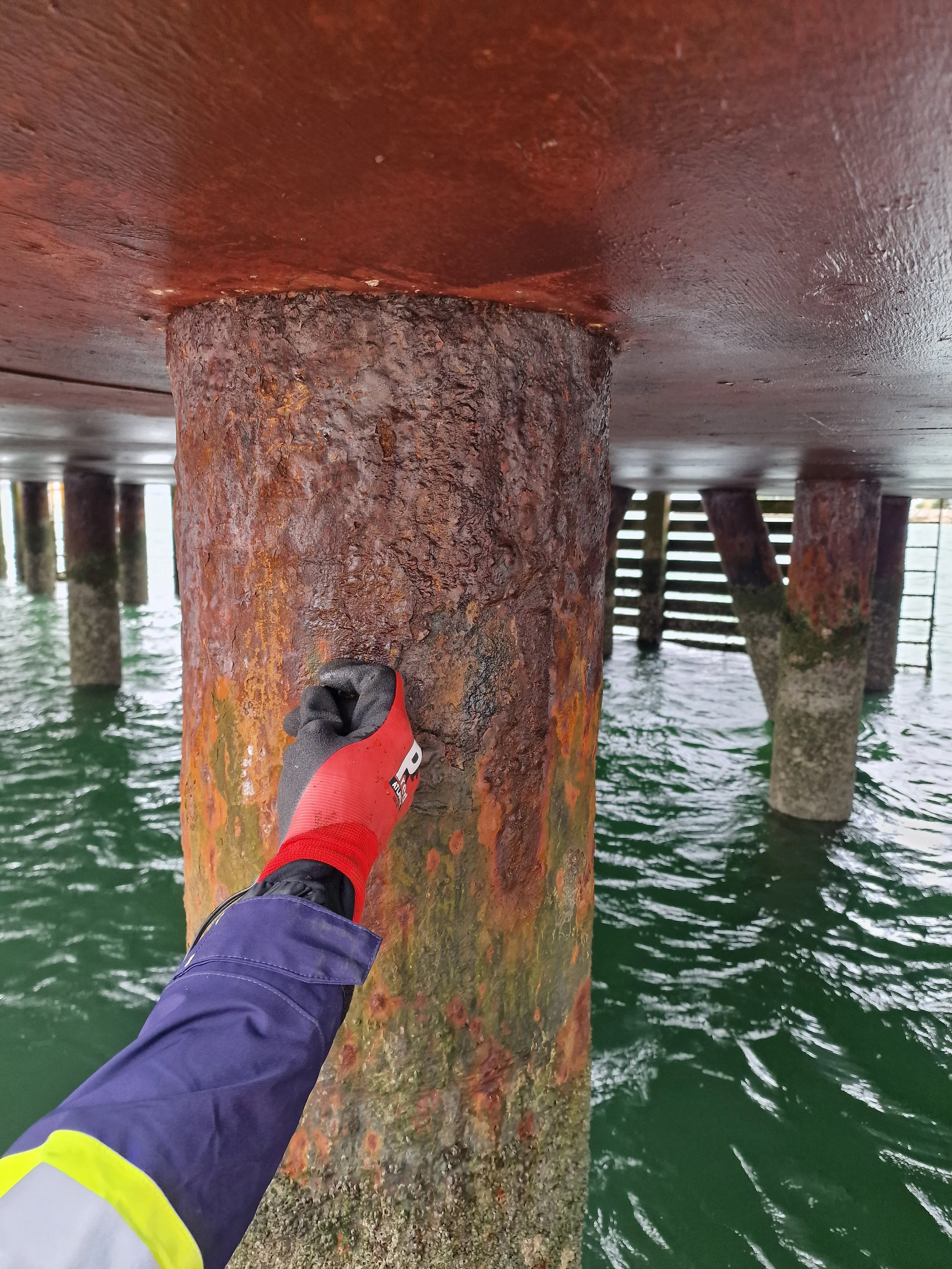
That might include corrosion beginning on steel members, cracking within concrete, movement around joints, damaged fenders, missing bolts or signs that scour is developing around foundations.
Individually these defects may not be particularly significant.
Together they often tell the story of how the asset is ageing.
That's why engineering judgement is just as important as the inspection itself.
Recording defects properly
Every defect we identify is photographed and recorded.
Where appropriate we'll take measurements, map the location of defects and assess their likely cause.
Rather than simply saying something is "damaged", we explain what the defect means and whether it's something that should be repaired immediately, monitored or simply recorded for future inspections.
This allows clients to prioritise maintenance rather than reacting to every defect in the same way.
Sometimes we use drones
Drone surveys have become a really useful tool for inspecting marine infrastructure.
They allow us to safely inspect structures that would previously have required scaffolding, cherry pickers or rope access.
They're particularly useful for:
quay walls
harbour structures
flood defences
bridges
tall retaining walls
inaccessible areas
The images they capture are also invaluable for future inspections because they provide an accurate visual record of the asset over time.
That said, drones don't replace engineers.
They're simply another way of gathering information.
What about underwater inspections?
One of the biggest challenges with marine structures is that some of the most important elements sit below the waterline.
Where the condition of piles, toe protection or submerged steelwork needs to be assessed, we may recommend underwater inspections.
Depending on the project, this might involve commercial divers, remotely operated vehicles (ROVs) or underwater camera systems.
Not every structure needs a dive survey.
The right approach depends on the asset, the risks involved and the level of detail required.
Do you carry out testing as well?
Sometimes.
Visual inspections are often enough to understand the condition of a structure.
On other projects we may recommend additional investigations such as ultrasonic thickness measurements, concrete testing or other forms of non-destructive testing.
These techniques help us understand what's happening beneath the surface without causing unnecessary damage to the structure.
Again, it comes back to carrying out the right level of investigation for the decisions that need to be made.
What happens after the site visit?
This is where the inspection becomes valuable.
Anyone can produce a report full of photographs.
The real value comes from explaining what those photographs mean.
Our reports don't simply list defects.
We explain:
the condition of the structure
likely causes of deterioration
any immediate concerns
recommended repairs
maintenance priorities
suggested inspection intervals
opportunities to extend the life of the asset
The aim is always to provide practical engineering advice rather than simply identifying problems.
Will the inspection tell me if the structure is safe?
Where appropriate, we'll comment on any defects that could affect the continued operation of the structure.
However, it's important to understand that a visual inspection is different from a detailed structural assessment.
If there are concerns regarding load capacity, future redevelopment or significant changes in operational use, further engineering assessment may be recommended.
We'll always explain when additional investigation is appropriate and, just as importantly, when it isn't.
Why regular inspections matter
The biggest benefit of regular inspections isn't finding defects.
It's understanding change.
Comparing today's condition with photographs and reports from previous years often tells us far more than a single inspection ever could.
Small changes are much easier—and considerably less expensive—to deal with than major structural failures.
That's why planned inspections form such an important part of effective marine asset management.
Frequently Asked Questions
-
Most inspections are completed within a day, although larger ports or more complex structures may require several site visits.
-
Usually not. We work closely with clients to minimise disruption and plan inspections around operational requirements wherever possible.
-
Yes. Where necessary we can utilise underwater cameras, ROVs or commercial divers depending on the project.
-
Absolutely. Our reports include clear photographic records together with explanations and engineering recommendations.
-
Yes. One of the main purposes of the inspection is to help clients understand which repairs should be prioritised and how maintenance budgets can be spent most effectively.
Thinking about arranging an inspection?
Whether you're responsible for a commercial port, marina, dry dock or waterfront development, understanding the condition of your marine assets is the first step towards protecting them.
At TILT Engineering & Design, we provide independent marine structural inspections across the UK, helping clients understand the current condition of their assets and plan practical, cost-effective maintenance strategies.
If you'd like to discuss an inspection, we'd be happy to have an informal conversation about your project.