
How Often Should a Quay Wall Be Inspected?
If you own, operate or manage a quay wall, sooner or later you'll ask yourself the same question:
"How often should we inspect it?"
The honest answer is... it depends.
The age of the structure, the type of construction, the environment it's in, how heavily it's used and whether there have been any significant changes all affect how frequently inspections should be carried out.
Unfortunately, many quay walls only receive attention when something goes wrong. By that point, repair options are often more limited, disruption is greater and costs can increase significantly.
Regular inspections don't just identify defects. They help you understand how your asset is changing over time so you can make informed decisions about maintenance, repairs and future investment.
Why quay wall inspections matter
Marine structures have a hard life.
They're exposed to saltwater, changing tides, vessel impacts, freeze-thaw cycles, abrasion, corrosion and constant loading. Even well-designed structures deteriorate over time.
The aim of an inspection isn't necessarily to find problems.
It's to understand the current condition of the asset, identify trends and intervene before relatively small defects become major structural issues.
A planned maintenance programme is almost always more cost-effective than emergency repairs.
There isn't a one-size-fits-all answer
One of the questions we're asked most is, "So... how often should we inspect it?"
The answer is usually another question; "Tell us a bit about the structure."
A busy commercial berth taking large vessels every day needs looking after very differently to an old masonry river wall that's barely changed in fifty years.
When we decide how often an asset should be inspected, we're looking at the bigger picture. How old is it? What's it made from? Has it had repairs before? Is it exposed to heavy vessel traffic or a particularly aggressive marine environment? And perhaps most importantly, what would happen if something did fail?
A good inspection programme isn't built around an arbitrary number of years. It's built around understanding the risk.
Did you know that different quay wall types have different risks…
Sheet piled quay walls
Steel sheet piles are extremely common around UK ports.
The biggest concern is corrosion.
Particular attention is normally paid to:
Splash zone corrosion
Low water corrosion
Coating breakdown
Tie rods
Anchor systems
Walings
Local deformation
Vessel impact damage
Because deterioration can occur below the waterline, underwater inspections often form part of the inspection programme.
Reinforced concrete quay walls
Concrete performs well in marine environments but is still vulnerable to deterioration.
Typical defects include:
Cracking
Concrete spalling
Reinforcement corrosion
Chloride attack
Delamination
Joint movement
Surface scaling
The visible damage isn't always the whole story. Corrosion can be developing behind apparently sound concrete long before significant defects become obvious.
Gravity walls
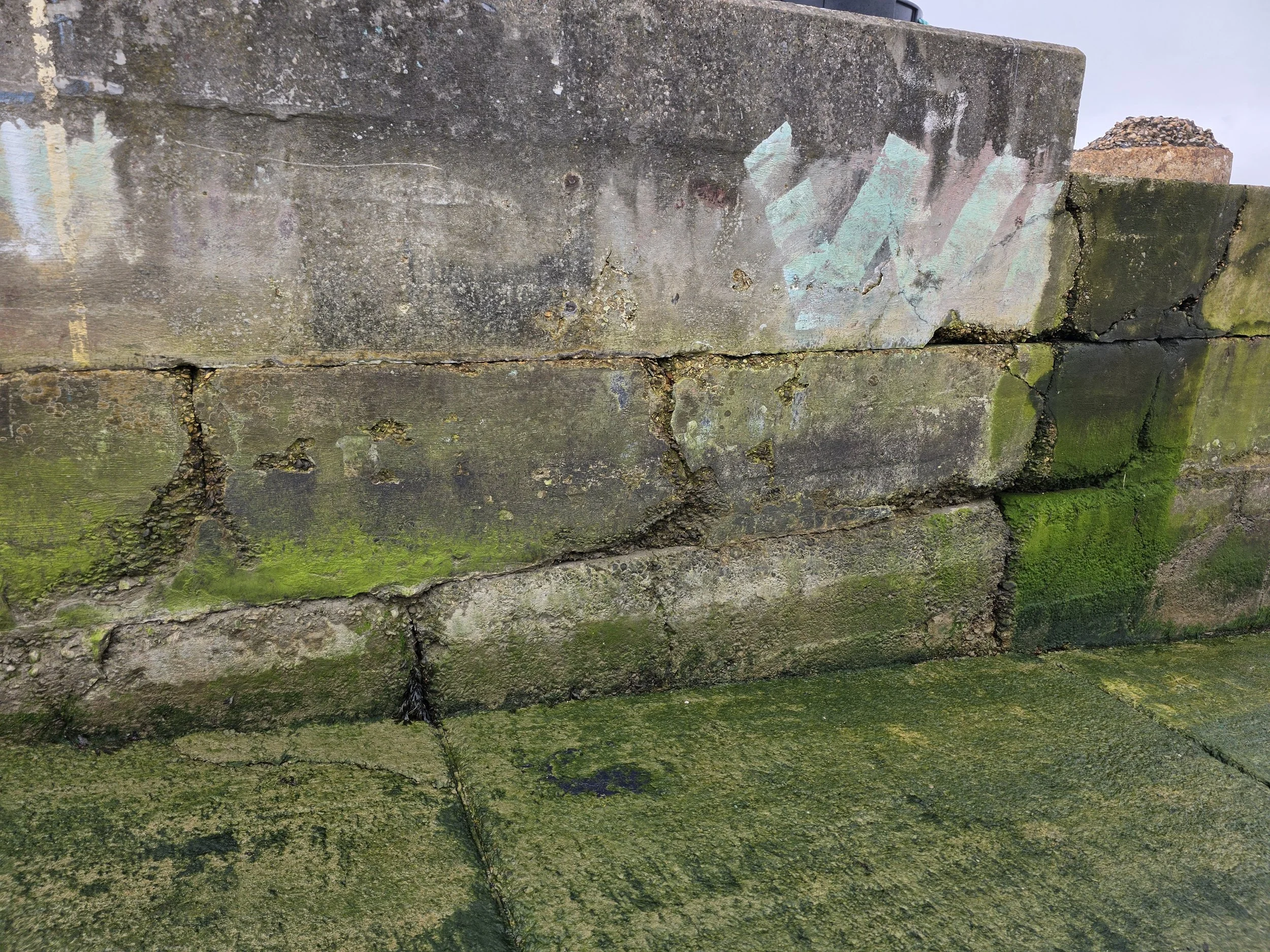
Older masonry or mass concrete walls are often extremely robust but can still suffer from:
Joint deterioration
Settlement
Movement
Local scour
Water ingress
Vegetation growth
Displaced masonry
Many older ports contain structures that have been performing well for well over a century, but understanding their condition is still essential when planning future developments.
What guidance should you follow?
There isn't a single UK law that states exactly how often a quay wall must be inspected.
Instead, inspection programmes are generally developed using engineering judgement alongside recognised industry guidance.
Documents commonly referenced include guidance published by organisations such as:
PIANC (World Association for Waterborne Transport Infrastructure)
CIRIA
The Port Marine Safety Code
Asset management standards such as ISO 55001 where appropriate
Individual port asset management procedures
These documents promote a risk-based approach rather than prescribing fixed inspection intervals.
So how often should inspections take place?
Every asset is different, but a typical approach might include:
Routine operational inspections
Every 6–12 months.
These are generally visual inspections carried out by site teams looking for obvious defects such as impact damage, loose coping stones, damaged fenders or excessive movement.
General condition inspections
Every 2–5 years.
These are typically carried out by experienced marine engineers and provide a more detailed assessment of the asset's condition, deterioration mechanisms and maintenance priorities.
Principal inspections
Every 6–10 years.
These involve much more detailed inspections and may include:
Close-up access
Rope access
Boat inspections
Drone surveys
Ultrasonic thickness measurements
Underwater inspections
Material testing where required
Special inspections
Immediately following events such as:
Vessel impacts
Storm damage
Flooding
Ground movement
Significant changes in loading
Fire
Structural concerns raised during routine inspections
Waiting until the next planned inspection after a significant incident is rarely appropriate.
What are we actually looking for?
Clients often assume we're looking for one major defect that suddenly tells us the structure has reached the end of its life.
In reality, it's rarely that dramatic.
Most inspections involve spotting lots of relatively small signs of deterioration and understanding what they're telling us. That might be corrosion starting around steelwork, cracking in concrete, movement in coping stones, damaged fenders or evidence that scour is developing around the base of the structure.
On their own, many of these defects aren't an immediate concern.
The important question is whether they're changing.
That's why regular inspections are so valuable. Comparing today's condition with photographs and reports from five years ago often tells us far more than a single inspection ever could.
What happens if inspections are left too long?
We've seen examples where relatively inexpensive repairs could have added decades to the life of a marine asset.
Instead, because deterioration wasn't identified early enough, much larger interventions became necessary.
The consequences can include:
Unexpected closures
Operational disruption
Increased repair costs
Emergency works
Reduced asset life
Safety risks
Difficulty securing funding for planned maintenance
In many cases, inspections pay for themselves simply by allowing maintenance to be planned rather than reacting to failures.
What happens during an inspection?
Every project is a little different, but most inspections follow a similar process.
Before we even arrive on site, we'll usually review any drawings, previous inspection reports or historical information that helps us understand how the structure was built and whether there are any known issues.
Once on site, we carry out a detailed visual inspection, recording defects with photographs, measurements and notes as we go. Depending on the asset, this might involve working from the quay itself, from a workboat, by drone or, where necessary, alongside specialist diving teams.
Back in the office, we bring everything together into a report that doesn't just list defects. We explain what we've found, what it means, how urgent any repairs are and where we think maintenance budgets should be focused.
Our aim is always the same: to give clients enough information to make confident decisions.
Where do drones fit in?
Drone technology has become a really useful tool for inspecting marine structures, but it's important not to see it as a replacement for engineers.
What drones do brilliantly is give us safe access to areas that are difficult, expensive or disruptive to reach by traditional methods. Long quay walls, harbour structures and high retaining walls can often be inspected in a fraction of the time without the need for scaffolding or specialist access equipment.
That said, drones can only show us what they can see. They can't inspect underwater elements or replace engineering judgement. We see them as another tool in the toolbox rather than the answer to every inspection.
And what about underwater inspections?
Of course, one of the biggest challenges with marine structures is that a significant proportion of them sits below the waterline.
If we're concerned about piles, scour, toe protection or submerged steelwork, we may recommend an underwater inspection. Depending on the project, that could involve commercial divers, remotely operated vehicles (ROVs) or underwater camera systems.
The right approach depends on the structure, the level of detail required and, naturally, the available budget. Not every inspection needs divers, but where critical structural elements can't be seen from above the water, they're often an essential part of understanding the true condition of the asset.
How much does a quay wall inspection cost?
This is one of the questions we're asked most often.
There isn't a single answer because inspections vary enormously.
The cost depends on factors such as:
Length of quay wall
Accessibility
Tidal constraints
Whether boats are required
Whether divers or drones are needed
The level of reporting required
A simple visual inspection is obviously very different from a full structural assessment supported by underwater surveys and materials testing.
The important thing is to match the inspection to the decisions you need to make, -there's little value paying for investigations that don't answer your questions.
Frequently Asked Questions
-
Yes. Most inspections can be planned around operational requirements to minimise disruption.
-
Usually not. We regularly work around operational activities, tidal windows and vessel movements.
-
Not entirely. Drones are an excellent inspection tool but don't replace engineering judgement or underwater investigations where these are needed.
-
Yes. A good inspection report should prioritise defects based on risk, helping you plan maintenance and budgets.
-
Definitely not. Many older marine structures continue to perform well. The key is understanding their condition and managing deterioration appropriately.
-
Yes. We regularly support clients with repair strategies, engineering design, temporary works and construction support following inspections.
Planning an inspection?
Whether you're responsible for a commercial port, marina, local authority asset or private waterfront structure, understanding its condition is the first step towards managing it effectively.
At TILT Engineering & Design, we carry out independent inspections of marine and waterfront structures across the UK. Our reports don't just identify defects—they help clients understand what those defects mean, what needs attention now, what can wait and how to maximise the life of their assets.
If you'd like to discuss an inspection or simply want some advice on the right approach for your asset, we'd be happy to help.
Talk to one of our Chartered Marine Civil Engineers today.